.svg)
Last updated September 22, 2026.
If you sell print on demand products to customers in Europe, VAT touches two separate transactions: the one where your supplier invoices you, and the one where you sell to your buyer. On Ownprint, the VAT on your order depends on where that order is delivered and on whether you have a valid EU VAT number on your account, and orders delivered outside the EU carry no VAT at all.
That is the short version. The long version is below, because VAT is the question I get asked most in our community, usually in a slightly worried tone, and it deserves a calm, complete answer. I am not an accountant, and this article is not tax advice for your specific situation. It is a plain explanation of how VAT works on print on demand orders, how Ownprint applies it, and what you need to do once so you never think about it again.
Print on demand is a chain of two sales. First, a buyer orders a personalized necklace from your shop. Second, you order that necklace from Ownprint, and Ownprint produces it and ships it to your buyer under your brand. Each of those sales has its own VAT logic, and mixing them up is where most of the confusion comes from.
The first sale, from you to your buyer, is your sale. You set the price, you collect the money, and whatever VAT obligations come with it are yours, exactly as they would be if you had made the necklace yourself. We come back to that at the end of the article.
The second sale, from Ownprint to you, is a business-to-business sale of goods shipped from the Netherlands. This is the one Ownprint calculates, charges, and puts on your invoice. It is also the one you can bring down to zero with a single verified VAT number, so let's start there.
Every price you see in the Ownprint catalog is a net price, without VAT. When you pay for an order, Ownprint works out the VAT for that specific order and adds it on top. Two things decide the outcome: the country the order is delivered to, and whether there is a valid EU VAT number on your account.
| Your situation | Order delivered to | VAT on your Ownprint invoice |
|---|---|---|
| Any seller, anywhere | Outside the EU (US, UK, Canada, Australia, Switzerland, Norway and so on) | 0%, export |
| EU business with a valid VAT number (except the Netherlands) | Inside the EU | 0%, reverse charged, your VAT number on the invoice |
| No VAT number, or the number could not be verified | Inside the EU | The standard rate of the delivery country |
| Any seller | The Netherlands | 21% Dutch VAT |
| Business based in the Netherlands | Anywhere in the EU | 21% Dutch VAT |
The rules run in that order, and the first one that matches wins. So a German seller with a verified VAT number pays 0% on an order to France, 0% on an order to the United States, and 21% on an order to Amsterdam, because goods that never leave the Netherlands always carry Dutch VAT.
If you sell mostly to the United States, which is true for a big share of Ownprint sellers, this table has good news in its first row: those orders never carry VAT on your invoice, whoever you are and wherever your business is registered.
When VAT does apply at the delivery country's rate, this is the rate Ownprint uses in 2026. Bookmark it; I will keep this table current when a country changes its rate, which usually happens on the first of January.
| Country | Rate | Country | Rate | Country | Rate |
|---|---|---|---|---|---|
| Austria | 20% | France | 20% | Malta | 18% |
| Belgium | 21% | Germany | 19% | Netherlands | 21% |
| Bulgaria | 20% | Greece | 24% | Poland | 23% |
| Croatia | 25% | Hungary | 27% | Portugal | 23% |
| Cyprus | 19% | Ireland | 23% | Romania | 21% |
| Czechia | 21% | Italy | 22% | Slovakia | 23% |
| Denmark | 25% | Latvia | 21% | Slovenia | 22% |
| Estonia | 24% | Lithuania | 21% | Spain | 21% |
| Finland | 25.5% | Luxembourg | 17% | Sweden | 25% |
Everything Ownprint makes, from necklaces and keychains to notebooks and packaging, is standard rated in every member state, and the shipping charged with the goods takes the same rate as the goods. Monaco follows the French rate. A few EU territories sit outside the EU VAT area even though they belong to a member state, the Canary Islands being the one that actually shows up in orders, and those are treated as exports at 0%.
If you run a VAT-registered business in an EU country other than the Netherlands, you should be paying 0% VAT on your Ownprint orders inside the EU. The only thing standing between you and that line on your invoice is a verified VAT number in your billing details.
Here is how it works. Open your billing details in the Ownprint dashboard and enter your VAT number, with the country prefix, for example DE for Germany or FR for France. The moment you save, Ownprint checks the number against VIES, the European Commission's VAT validation service, and shows you the result right there in the dialog. A valid number gets a green verdict and, from that moment on, every EU order you pay for is reverse charged.
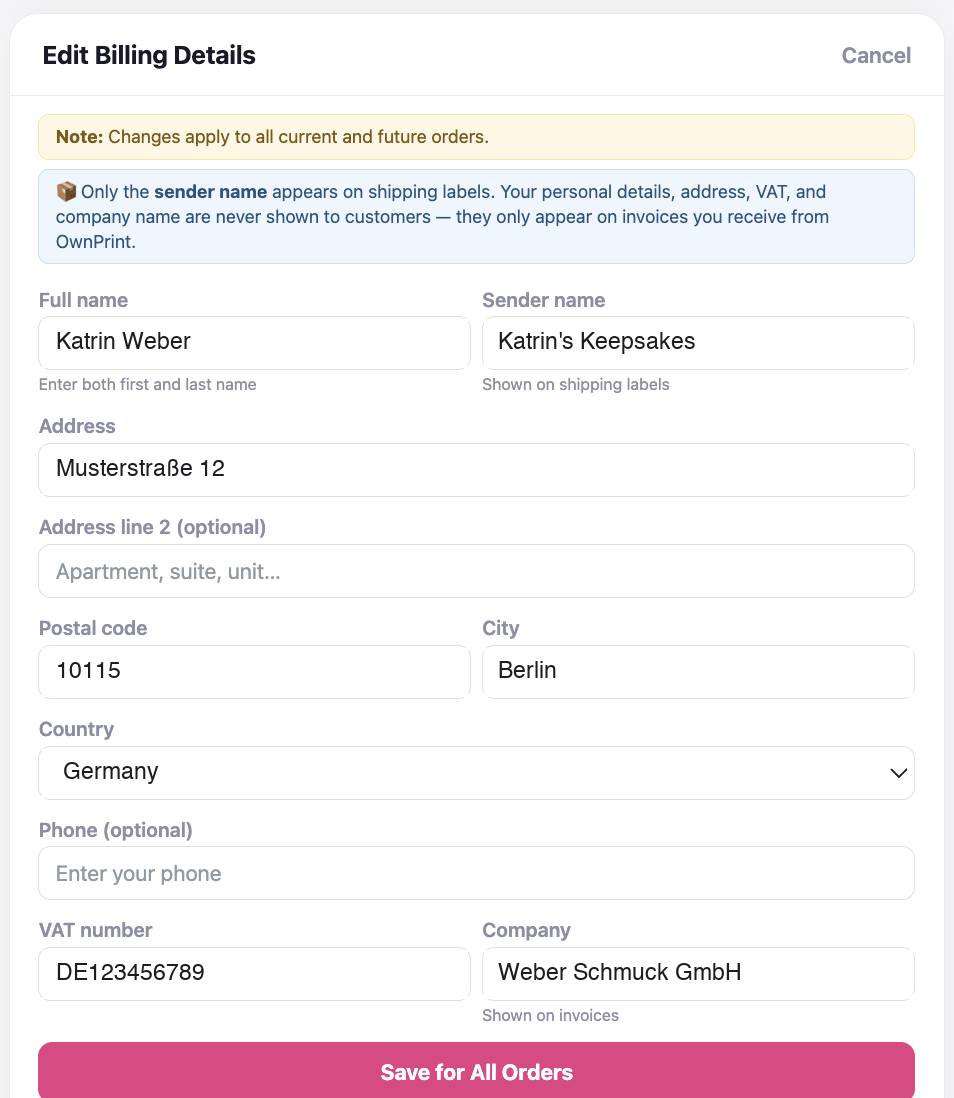
Three details make the check pass or fail, and they are worth knowing before you type:
Ownprint re-checks stored numbers automatically every so often, so a number that stops being valid, because a business closed or was deregistered, will not keep getting 0% forever. And if VIES itself is down when you save, which happens a few times a year, your record shows a pending status and is checked again within the hour. If a number cannot be validated at the moment you pay for an order, VAT is charged on that order, and the check runs again afterwards.
Every Ownprint invoice shows the delivery country of the order, the net amount per line, the VAT rate, the VAT amount and the total. Right above the total there is one line that tells you which rule applied, in words your accountant will recognise:
If an order is ever refunded or credited, the credit note uses the same rule and the same rate as the original invoice, never the rate of the day the refund happens. That keeps your books tidy.
Let me make this concrete with the kinds of sellers we see every day.
Katrin runs a registered print on demand shop in Germany and has her VAT number verified on Ownprint. Her orders to German and French buyers are reverse charged at 0%. Her orders to American buyers are exports at 0%. She accounts for the reverse-charged purchases in her German VAT return, which her accountant does in a few minutes each quarter. Her Ownprint invoices carry no VAT at all.
Sofía sells from Spain as a private person, no VAT registration yet. When her buyer is in Spain, her Ownprint order carries 21% Spanish VAT. When her buyer is in Italy, it carries 22% Italian VAT. When her buyer is in the United States, which is most of her sales, there is no VAT on the order. The day she registers for VAT and adds her number, her EU orders drop to 0%.
Mike sells from Texas and never thinks about VAT. His orders go to American buyers and every Ownprint invoice reads "VAT 0%, export outside the EU." If one of his buyers happens to be in Germany, that single order is delivered inside the EU and carries the German rate, because there is no EU VAT number on Mike's account to reverse charge against.
Daan sells from Rotterdam. His orders inside the EU carry 21% Dutch VAT whether or not he has a VAT number, because Ownprint and Daan are both in the Netherlands and that is a domestic sale. As a registered business he reclaims that VAT in his own return, so it costs him nothing in the end. His orders to buyers outside the EU are exports at 0%.
Now back to the first transaction, your sale to your buyer. This is the part where I have to say clearly that the rules depend on your country, your turnover and how you sell, and that your accountant is the right person to confirm your situation. What I can give you is the map.
If your business is in the EU and you sell to consumers in the EU, you charge VAT on your own sales once you are VAT registered. Small sellers usually start under their national registration threshold and charge nothing. Once your cross-border sales to consumers in other EU countries pass 10,000 euros a year in total, you charge the VAT of the buyer's country, and the One Stop Shop lets you declare all of that in one return at home instead of registering in every country.
If your business is outside the EU and you sell through a marketplace like Etsy, the marketplace is in most cases treated as the seller for VAT purposes on your EU sales and collects the VAT from the buyer at checkout. If you sell through your own Shopify store to EU buyers, the obligation can sit with you, and that is a conversation to have with an accountant before the sales get serious.
None of this changes what is on your Ownprint invoice. The supplier side is handled by the table above; the buyer side is yours, and it is the same for every supplier you will ever work with.
Do I need a VAT number to sell with Ownprint?
No. Ownprint is free to use and you can start selling without any VAT registration. A VAT number only changes what is on your invoice for orders delivered inside the EU: with a verified number those orders are reverse charged at 0%, without one they carry the delivery country's rate.
I am in the US. Will Ownprint ever charge me VAT?
No, not on orders delivered to the US. Orders delivered anywhere outside the EU carry no VAT at all, and that is almost every order a US seller places. VAT only shows up if one of your orders is delivered to a buyer inside the EU. That order carries the VAT of the country it is delivered to, for example 19% for Germany, because a US business has no EU VAT number that would let us reverse charge it.
My VAT number shows as invalid. What now?
Check three things: the country prefix matches your billing country, the number is complete, and it is currently active in VIES. You can test it yourself on the European Commission's VIES site. Until it validates, VAT is charged on your EU orders.
Is the VAT on my Ownprint invoice a cost for me?
If you are a VAT-registered business in the EU, no. Your EU orders are reverse charged at 0%, so there is no VAT on the invoice to begin with. The one exception is a business based in the Netherlands, which pays 21% Dutch VAT and claims it back in its own VAT return, so it costs nothing in the end either. If you are not VAT registered, the VAT on orders delivered inside the EU is a real cost, so price those orders with it in mind.
Do my buyers pay import duties or customs?
Not on EU and US orders. Ownprint produces EU orders in Rotterdam and US orders in California, so buyers in the EU and the US never see customs charges. Buyers in other countries may be charged import VAT or duties by their own customs on arrival, as with any international parcel.
Does the VAT change if I ship an order to the Netherlands?
Yes. Any order delivered inside the Netherlands carries 21% Dutch VAT, whoever the seller is, because the goods never leave the country they were produced in.
One minute in your billing details, and every EU order you pay for is reverse charged at 0%.
Open my billing details
Create and sell unique and high-margin print on demand jewelry products faster, cheaper, better.
START TODAY
Untapped, yet highly profitable. The most
unique pod products on the market

We help you grow your business by fulfilling your orders faster than ever